What does an AI receptionist cost in Australia?
It depends on the job, what it has to reach and your data. The cost is a one-off setup, a small retainer and the running costs, and the setup swings most with the edge cases. Andrei on how the price is made up.

It depends, and the honest way to answer is to start with what you want it to do. Two businesses can both say "I want an AI receptionist" and need completely different things.
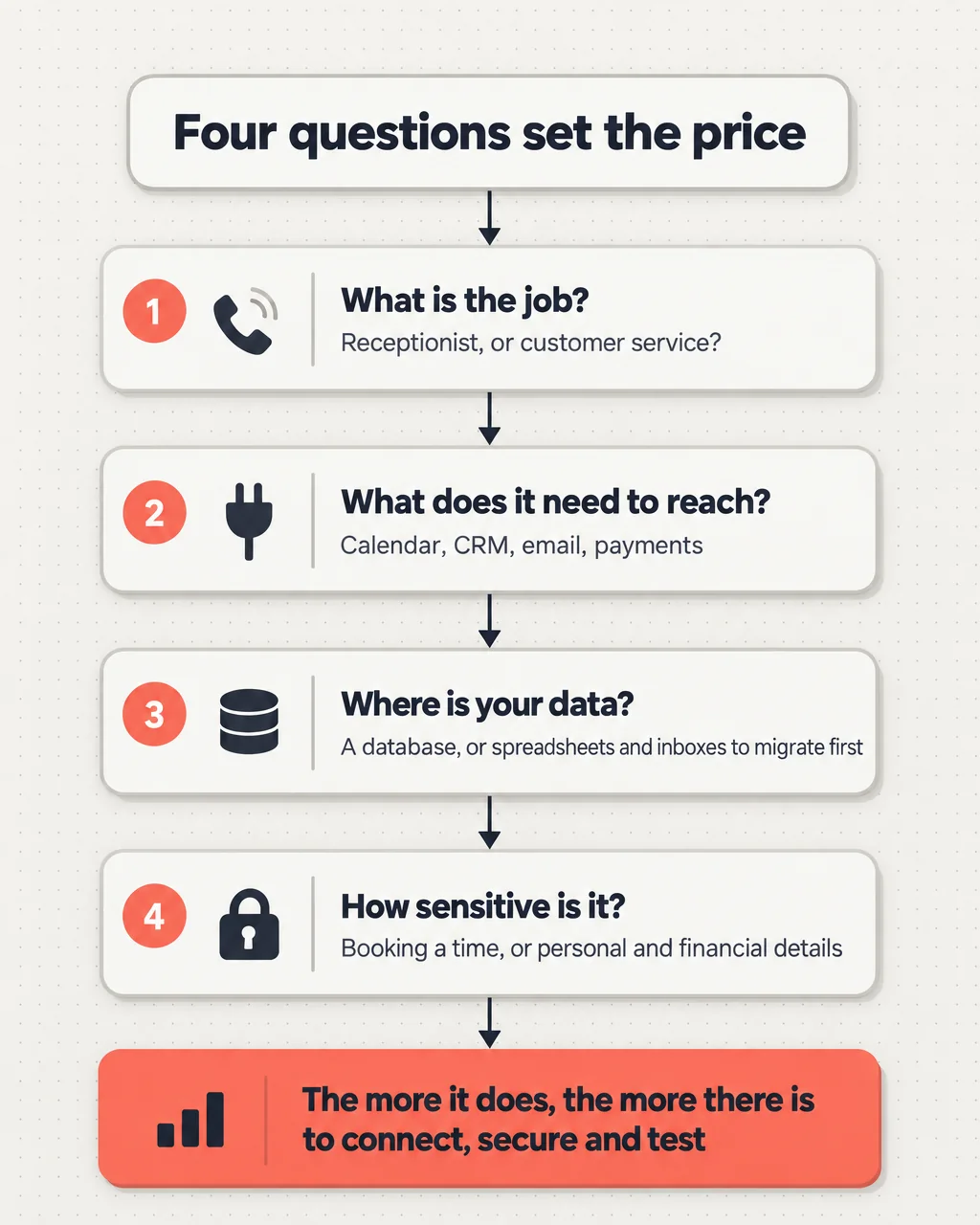
Start with the job. Is it a receptionist that answers the phone, takes details and books an appointment? Or is it customer service, where people ask about orders, accounts or problems? A receptionist is a narrow job with simple, predictable calls. Customer service is wide, the queries can be complex, and there's a lot more to set up and test.
Next, what does it need to reach? Does it only take a message, or does it use your other tools, like your calendar, your CRM, your email or your payments? Every tool it touches is more to connect, secure and test.
Then your data. Do you already have a database it can work with, or does your information live in spreadsheets and inboxes and need migrating first? Migrating adds work before the assistant can do anything useful.
Last, what kind of data is it dealing with, and how complex are the queries? Booking a time is simple. Looking up someone's job history, or handling personal or financial details, needs more care around privacy and security, and that takes more time to build.
Once you've worked that out, the cost breaks into three parts.
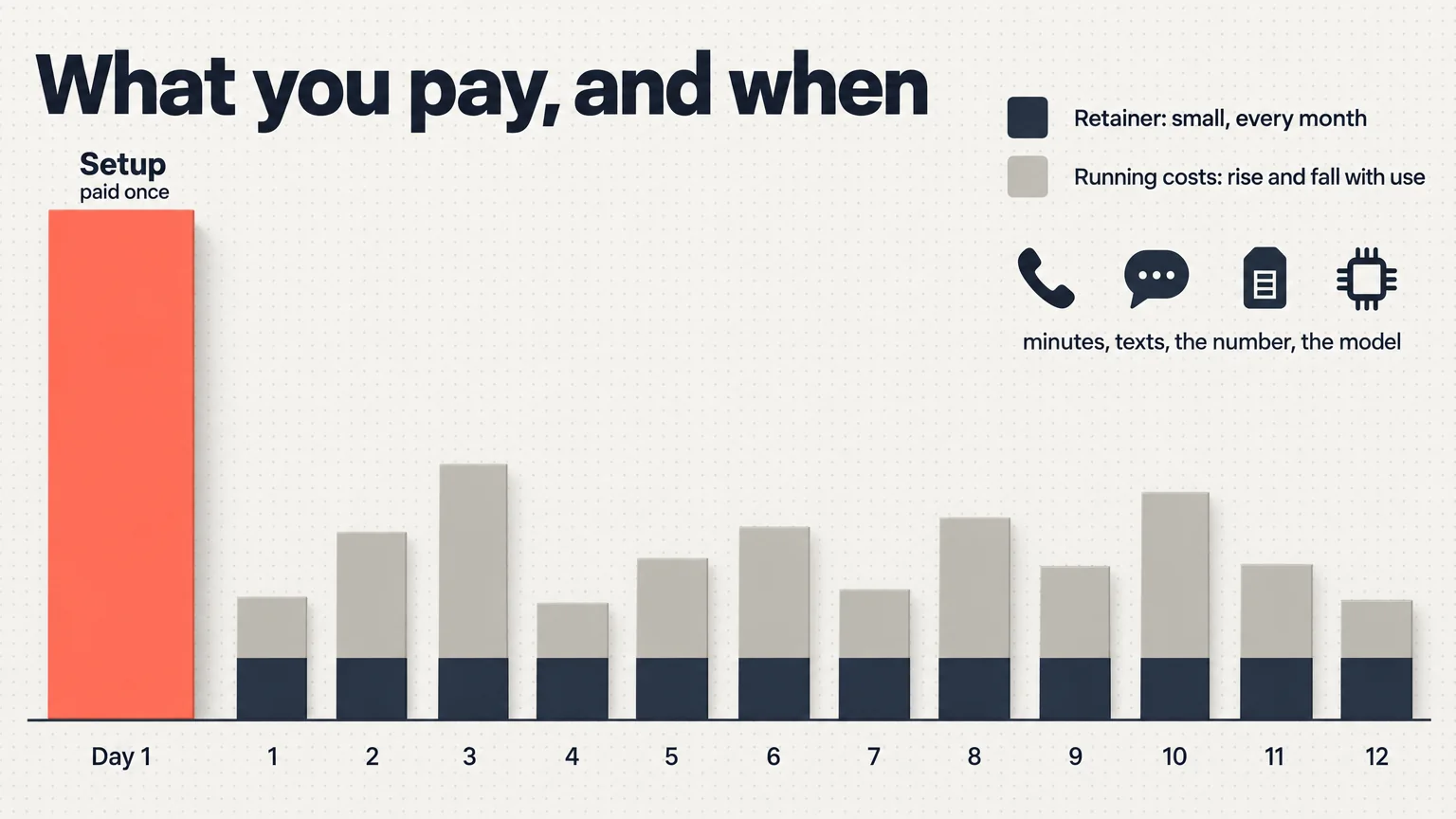
The setup comes first, and it's the larger sum. You pay it once. It covers building the assistant, connecting it to your tools and data, writing and testing its rules so it knows what to handle and what to leave alone, and tuning how it sounds.
The second is a small retainer for bug fixes and security updates. An AI that talks to your customers and touches your data needs looking after, like any other software.
The third is the running costs, which come from usage. Some of it is fixed, like the phone number and the platform plan, and some depends on how busy you are, like the minutes on calls, any texts it sends and the AI model behind it.
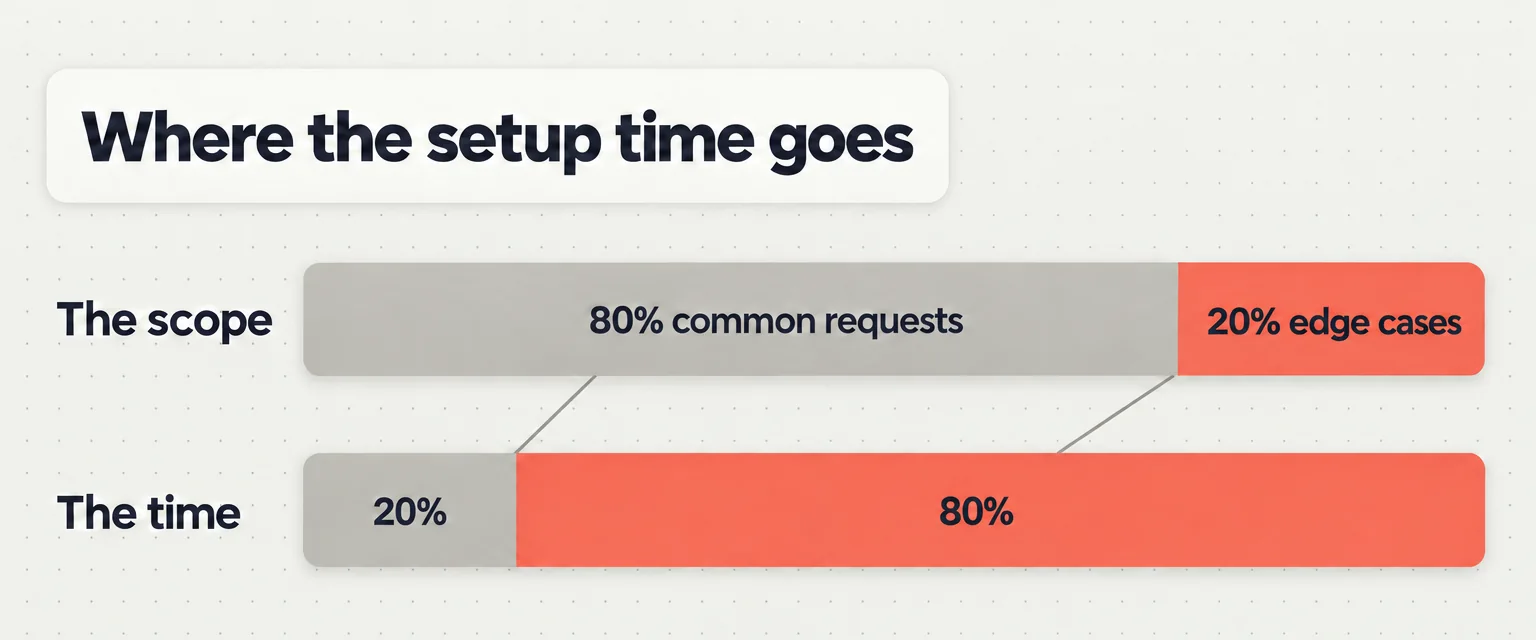
The setup is also where the price swings the most, and that comes down to how the work scales. As a rough rule of thumb, the first 80% of the questions and scope take about 20% of the development time, and the last 20%, the edge cases, take about 80% of it. By edge cases I mean how the agent interacts with your request and acts on it. Handling the common requests is the quick part. The time goes into everything that can go wrong when it acts: it books over an existing appointment, it changes the wrong customer's record, it does two things in the wrong order, it gets asked for something outside its job, or someone tries to talk it out of its rules. Every tool you give it adds more it can do, so it needs more guardrails and more testing, and there's more that can go wrong and break if it isn't developed properly. The bigger the scope, the more complex the queries and the more things there are to watch out for, the more this scales. A simple receptionist that takes details sits mostly in the easy 80%. An assistant with several tools and sensitive data spends most of its budget in the last 20%. That is why the price varies so much with scope and complexity.
For a small operation, the ongoing costs are usually in the hundreds of dollars a month. For a larger operation, they're in the thousands. Once it's built, that's insanely cheap compared to hiring a part-timer.